Dr Cordelia Galgut
Fear of Cancer Recurrence
For people living with or beyond cancer and those supporting them
Throwing a truthful light on life longer term, living either with a still present cancer or beyond it.
A note on the name. This work was formerly known as FOCRAP (Fear of Cancer Recurrence and Progression). The acronym FOCRAP is now retired, and Fear of Cancer Recurrence is the preferred term.
In this video, I talk from my dual perspective as a counselling psychologist and as a person who suffers cancer’s long term effects, about why I set up this website.
The reason for this page
Why this website?
I am setting up this website because people have asked for a resource that acknowledges, unequivocally, that life living with or beyond cancer is no bed of roses for many more people than is often recognised. I also hope that people working in the cancer field will find this website of use, to help them offer realistic, helpful support.
People get so fed up of being told to move on and having their feelings dismissed
People get really fed up of being told to stop complaining, move on, get over cancer, in ways they find impossible. Indeed it IS impossible to get over and move on, if you suffer longer term, after the initial treatments end. And many do. Amazingly, even people who are living with a still present cancer are expected to do this, even though most in this situation have to have invasive and unpleasant treatments to keep them alive.
Even those who are fortunately free of cancer after the initial treatments, almost always have to endure further treatments to try to keep the cancer at bay, eg. hormone treatments. These often have nasty side effects that affect quality of life.
Cancer treatments save lives but often cause nasty, long term effects
Additionally, treatments themselves can often cause nasty long term, physical effects. These are thankfully becoming a little more accepted, rather than swept under the carpet, but the extent of their prevalence is often underestimated and effects on people’s quality of life are often much more extreme than is generally accepted.
Fear of cancer recurrence and progression is very common but often doubted
One major long term effect, that is pretty universal, is the focus of this website, fear or often enough, extreme fear of recurrence or progression. It often amazes me that people doubt the prevalence of this.
However, the validity of these feelings is often brought into question in ways that beggar belief, but have become dominant beliefs over time; conventional wisdom, in fact.
Please explore the information available elsewhere on this website
Please see the results of my recent survey on peoples’ thoughts about fear of cancer recurrence and progression, and my book on Living with the Long Term Effects of Cancer, by pressing the relevant buttons on this page.
In their own words
Voices from the survey
“The fear never goes away- you just have to adapt and learn to deal with it. Life is no longer the same. No one really helps you voice and come to terms with these enormous feelings.”
Anon, FOCRAP Survey, Galgut 2022
“Professionals work on statistics. Someone has to be that statistic however low and I feel they don’t understand what they see as an illogical fear that I will be that statistic.”
Anon, FOCRAP Survey, Galgut 2022
“Our culture has a narrative about cancer that emphasises triumphant return to normal. I think that makes patients feel like they need to speak about their experiences as if they are stories with a definitive ending, even though cancer is mentally, and very often physically, something that never fully goes away.
This leads to medical professionals not understanding what we really go through, flawed research models with skewed results, and intense feelings of isolation for us patients who don’t know we are not alone in our fears.
Cancer never stops, even when you don’t know if it is still there. It’s a ghost that is always in the room with you. Sometimes you feel its presence and sometimes you can forget about it for a bit. But- even for those of us who are early stage – cancer is a permanently altered state of being into which we have been unwillingly thrust, not a story with a clean and definitive end point.”
Anon, FOCRAP Survey, Galgut 2022
The survey was called the FOCRAP survey at the time.
What people hear, and what helps
Myth and helpful
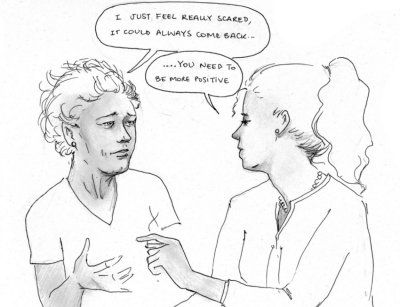
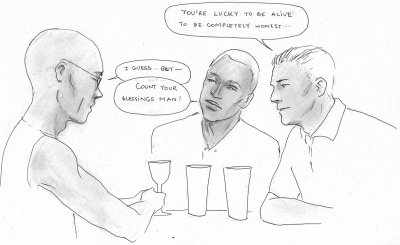
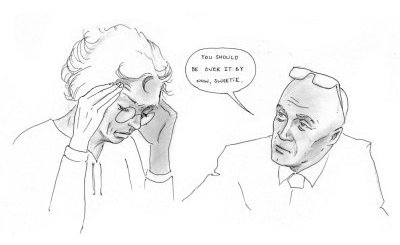
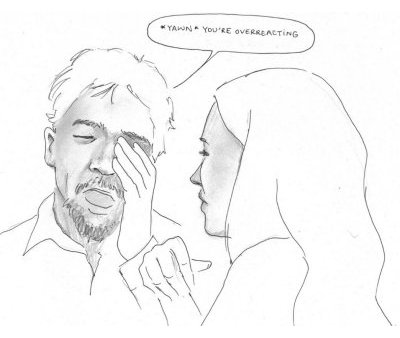
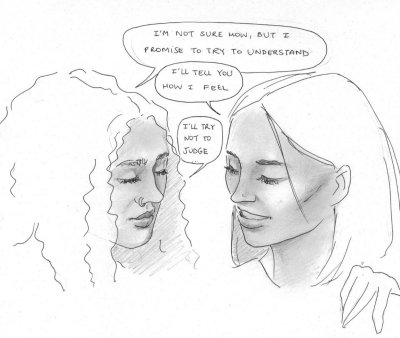
First published in my book, Living With The Long Term Effects of Cancer, 2020, reproduced with permission from JKP publishers. Image credit: Louise Bourgeois
Research and writing
Survey results
Out now, detailed article on my research on cancer recurrence and progression. This article was first published in Private Practice, March 2023 issue, published by BACP. ©
Please see this article on Why the Fear of Cancer Recurrence Is Often Misunderstood and How You Can Cope, including survey results
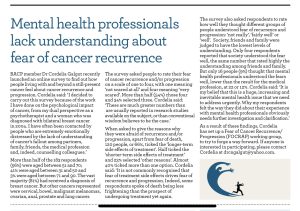
Click here to read my article that was in the BACP Journal Jan 2023 and discusses some of the FOCRAP survey results
Here is my latest British Medical Journal blog on fear of cancer recurrence.

Real experiences
Video testimonies
Living alongside it
Coping strategies
I hope this website will offer you a number of coping strategies.
Sufferers is not a word I would generally want to associate with those of us who cope daily with a range of debilitating effects. It doesn’t seem very empowering, even though we do suffer. However, if I use a phrase such as “sufferers as experts”, I hope that feels different. The button called Have Your Say on this website, is precisely so that people can share their ways of coping day by day. I hope your experiences/ideas will help, not only those of us coping with fear of cancer recurrence and progression, to name just one long term effect of cancer, but also offer support to others with lots of the other issues that arise when living beyond or with a still present cancer.
I also hope those supporting us, namely healthcare professionals plus family friends, colleagues, etc. will benefit by getting a better understanding through reading the content on this site. You could also send a link to anyone you would like to understand better, to save you having to speak to them directly, for example.
Mental health professionals want to help.
However… In mental health, we want to help, of course. In the process, there is a tendency to offer models of recovery, for example. The trouble is that many of us living beyond or with a still present cancer, cannot recover, move on etc. in the way these approaches expect us to. As both a psychologist and a sufferer of long term effects, I get caught up in the conflicts that arise when we try to solve problems that cannot be solved because the problems inevitably remain. For example, you can’t ‘get over cancer’ when you are still suffering its effects. Fear of recurrence and progression is a pretty universal one, for example.
In order to help us cope, there needs to be a move away from making people feel that they have to get over cancer or there is something psychologically wrong with them because they can’t, to an approach that recognises the reality of what many of us cope with ongoingly.
If the question becomes, how can we help you to live alongside all the effects, which we know are real, and also shift the narrative away from, it’s just the minority to it’s a lot of people, that would be very helpful. This website could do that by becoming a community of voices speaking out about how life really is and what we really need to help us get through.
Validation is key
Obviously, validating the reality rather than belittling it, dismissing etc. is often extremely helpful. I know it isn’t practical help and many, including me, need that. However, just being told you are believed, can pull people back from the brink, as I know full well from all the messages I have had over the years. If someone says, ‘ Look, I totally believe and feel for you. You’re not a fraud. It’s others who are ignorant and need educating.’ That, in itself, can be a huge game changer for people and help them see their lives differently and most importantly, feel more able to cope and more empowered.
You might find the Cancer.Net blogs of use, and other things i have written, shorter and longer. See my Homepage on cordeliagalgut.co.uk for the relevant links.
Below is the poem I wrote back in 2010. Lots of people have said it empowers them to speak out, or they simply show it to others to help them understand.
From the book, ‘Emotional Support Through Breast Cancer’ written by Dr Cordelia Galgut
Please don’t ….
Please don’t tell me how I should feel
Or what I should think about having breast cancer;
How I should be ‘over it’ by now;
How I should be more positive;
How I should be grateful that I’m alive.
And please don’t say, ‘You’re over-reacting to your situation.
It’s only you who feels like this’, or
‘It’s time you got on with your life.’
How can you know? You have never been in my situation.
And please don’t ask me what I have contributed to my cancer
Or tell me how brave I’ve been.
There was no choice is all.
It was just the luck of the draw.
And please don’t ask me how my breast cancer journey has been.
There was no journey.
There is no journey, because there is no end in sight.
And for pity’s sake, don’t say,
‘Well, we’re all going to die in the end.
I could get run over by a bus tomorrow.’
It’s different
You have never stared death head on.
You have never had breast cancer.
We are on different sides of the track now.
Tell me instead
That you cannot know what it is like living through this hell.
Tell me instead that you have an open heart
And an open mind.
That you’ll listen,
That you’ll try and understand,
Even when what I’m saying sounds preposterous to you.
It is my reality.
And please, please try and look beyond your own fears,
Or if you can’t, tell me so.
Having breast cancer is terrifying
And the terror does not diminish,
Because the fear that it will come back is ever present.
So please, please don’t tell me that I’m one of the lucky ones,
That I’ll be back to normal soon,
Because my life and I have been changed forever.
Cordelia Galgut

The person behind this page
About me
Qualifications and Experience
- I have a doctorate, MA and PGDip in psychology, counselling and psychotherapy.
- I am a BPS Chartered Psychologist, a Fellow of the BPS, an HCPC Registered Counselling Psychologist and a Registered BACP Counsellor and Psychotherapist.
- I have enjoyed running my own private counselling and psychotherapy practice since 1996, supporting clients (individuals and couples).
I have also authored three books and many articles on the psychological impact of cancer. Please look at my main website for more information about these. My last book, Living With the Long Term Effects of Cancer features on my homepage, listing all associated publications, too.
I tend to write from my dual perspective as a psychologist who has also had cancer because I think this is more honest and people say it is more helpful than writing from just one perspective.
When I was first diagnosed, it was such a shock to find how little understanding I had had about what having cancer is really like, so writing from my dual perspective, I tend to highlight all the myths about living with cancer, eg. you’re over it in a year or so, etc. Lots of responses from others living on after or with a still present cancer confirm how important it is to validate the reality of what we go through, rather than the fantasies!
Hopefully this website is a helpful continuation of my work in this area. For more information about my work/me, please press the ‘my main website’ button.
Read more
Articles
No articles yet. Please check back soon.
My heartfelt thanks to Sue Medley, Louise Bourgeois and my focus group for their help and support with developing this website.